
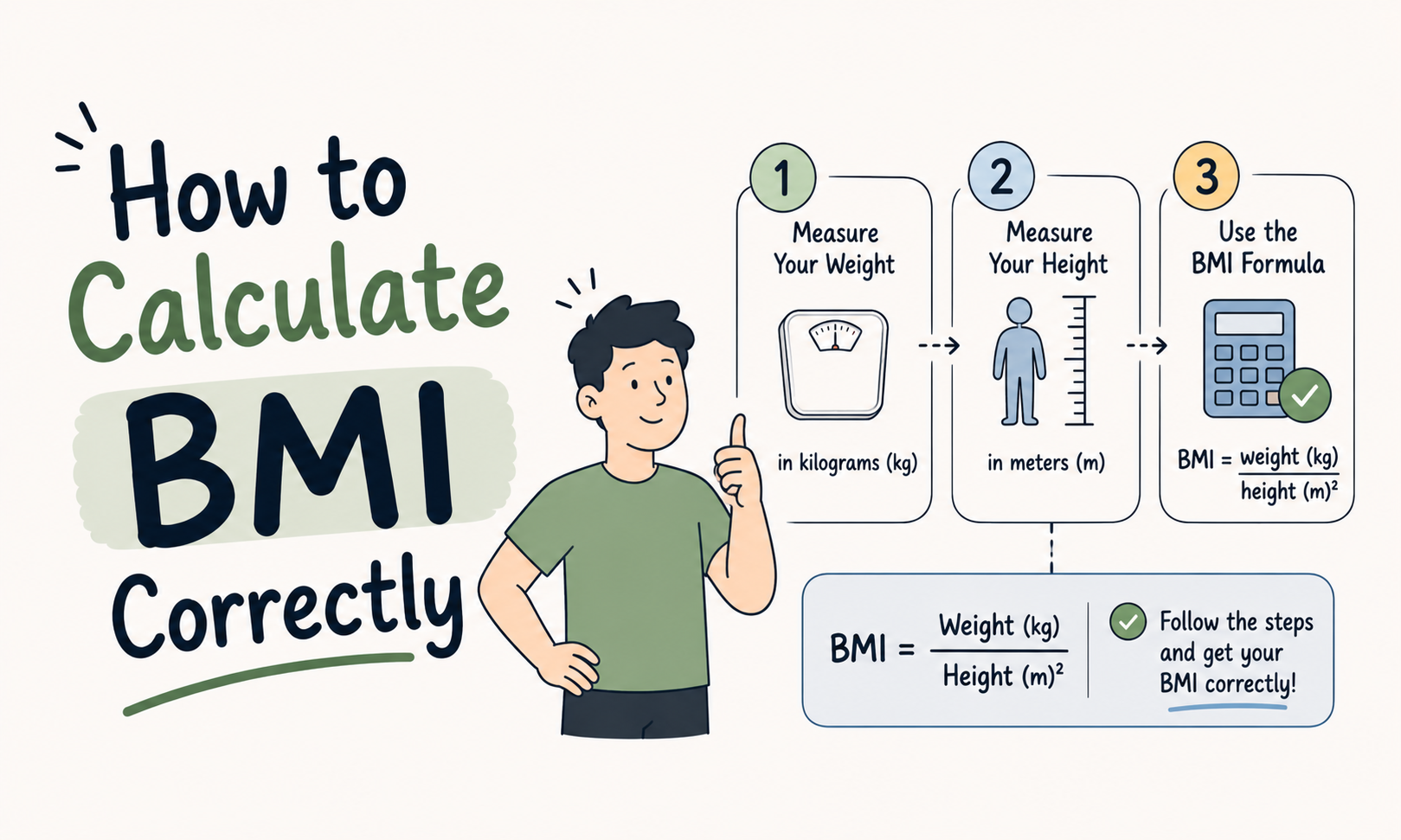
Knowing how to calculate your Body Mass Index (BMI) is one of the easiest ways to understand whether your weight falls within a healthy range. BMI is widely used by healthcare professionals because it provides a quick estimate of weight status based on your height and weight.
Although the calculation itself is straightforward, many people make mistakes by using incorrect units or entering inaccurate measurements. This guide explains how to calculate BMI correctly, compares metric and imperial formulas, highlights common errors, and shows why online BMI calculators are often the best option.
How to Calculate BMI Step by Step
Calculating BMI requires only two pieces of information:
- Your weight
- Your height
Follow these simple steps.
Step 1: Measure Your Weight
Use a reliable weighing scale and record your weight.
- Metric: kilograms (kg)
- Imperial: pounds (lb)
For the most accurate result, weigh yourself in light clothing and without shoes.
Step 2: Measure Your Height
Stand against a wall without shoes and measure your height.
- Metric: meters (m)
- Imperial: inches (in)
If your height is measured in centimeters, divide it by 100 to convert it into meters.
Example:
- 170 cm = 1.70 m
Step 3: Apply the BMI Formula
Once you have your height and weight, use the appropriate BMI formula based on your preferred measurement system.
The resulting number is your Body Mass Index.
Step 4: Compare Your Result
For adults, the standard BMI categories are:
| BMI | Weight Category |
|---|---|
| Below 18.5 | Underweight |
| 18.5 – 24.9 | Healthy Weight |
| 25.0 – 29.9 | Overweight |
| 30.0 and above | Obesity |
Remember that BMI is only a screening tool and should not be considered a medical diagnosis.
BMI Formula Explained with Examples
There are two commonly used BMI formulas depending on your measurement system.
Metric Formula
BMI = Weight (kg) ÷ Height² (m²)
Example
Weight: 72 kg
Height: 1.75 m
BMI = 72 ÷ (1.75 × 1.75)
BMI = 72 ÷ 3.0625
BMI = 23.5
This falls within the Healthy Weight category.
Imperial Formula
BMI = (Weight (lb) × 703) ÷ Height² (in²)
Example
Weight: 180 lb
Height: 70 inches
BMI = (180 × 703) ÷ 4900
BMI = 126,540 ÷ 4900
BMI = 25.8
This falls within the Overweight category.
Although the formulas look different, they produce the same result when the measurements are entered correctly.
Calculate Your BMI Instantly
Instead of calculating BMI manually, save time and avoid mistakes by using the free Howtigo BMI Calculator.
Simply enter your height and weight to receive an instant BMI score along with your weight category.
Metric vs Imperial BMI Calculation
BMI can be calculated using either the metric or imperial system.
Metric System
Uses:
- Kilograms (kg)
- Meters (m)
Formula:
BMI = Weight (kg) ÷ Height² (m²)
The metric formula is used in most countries around the world.
Imperial System
Uses:
- Pounds (lb)
- Inches (in)
Formula:
BMI = (Weight × 703) ÷ Height²
The multiplication factor of 703 converts imperial measurements into the same BMI value produced by the metric formula.
Which One Is Better?
Neither formula is more accurate.
The only difference is the measurement units you use. As long as the correct units are entered, both formulas produce identical BMI values.
Common BMI Calculation Mistakes
Although BMI is easy to calculate, several common mistakes can lead to inaccurate results.
Using the Wrong Units
One of the biggest mistakes is mixing measurement systems.
For example:
- Entering kilograms while using the imperial formula.
- Entering centimeters instead of meters.
Always use the correct units before calculating BMI.
Forgetting to Square Your Height
The BMI formula requires your height to be multiplied by itself.
Example:
1.70 × 1.70
Not:
1.70 × 2
This is one of the most common calculation errors.
Measuring Height Incorrectly
Your height should be measured without shoes while standing upright against a wall.
Even a few centimeters can noticeably affect your BMI result.
Using Old Weight Measurements
If you've recently gained or lost weight, update your weight before calculating BMI.
Outdated measurements produce misleading results.
Expecting BMI to Measure Body Fat
BMI estimates weight relative to height.
It does not directly measure:
- Body fat percentage
- Muscle mass
- Bone density
- Fitness level
For a complete health assessment, BMI should be combined with other measurements and medical advice.
Why Online BMI Calculators Are More Convenient
Although calculating BMI by hand is useful for understanding the formula, online BMI calculators offer several advantages.
Faster Results
Your BMI is calculated instantly without manual calculations.
More Accurate
Online calculators automatically perform the formula, reducing the risk of mathematical errors.
Easy to Use
Simply enter:
- Height
- Weight
The calculator does the rest.
Instant Weight Classification
Most BMI calculators immediately show whether your result falls into:
- Underweight
- Healthy Weight
- Overweight
- Obesity
This makes interpretation much easier.
Great for Regular Monitoring
If you're tracking your fitness journey or weight-loss progress, online BMI calculators allow you to check your BMI anytime with minimal effort.
Summary
Calculating your BMI is a quick and effective way to estimate whether your weight is appropriate for your height. Whether you use the metric or imperial formula, the key is entering accurate height and weight measurements using the correct units.
While manual calculations help you understand how BMI works, online BMI calculators eliminate common mistakes and provide instant, reliable results. Remember that BMI is only a screening tool and should be used alongside other health indicators, such as physical activity, diet, and medical advice, for a more complete understanding of your health.
Calculate Your BMI Today
Ready to find out your BMI?
Use the free Howtigo BMI Calculator to calculate your Body Mass Index instantly, understand your weight category, and start making informed decisions about your health.