
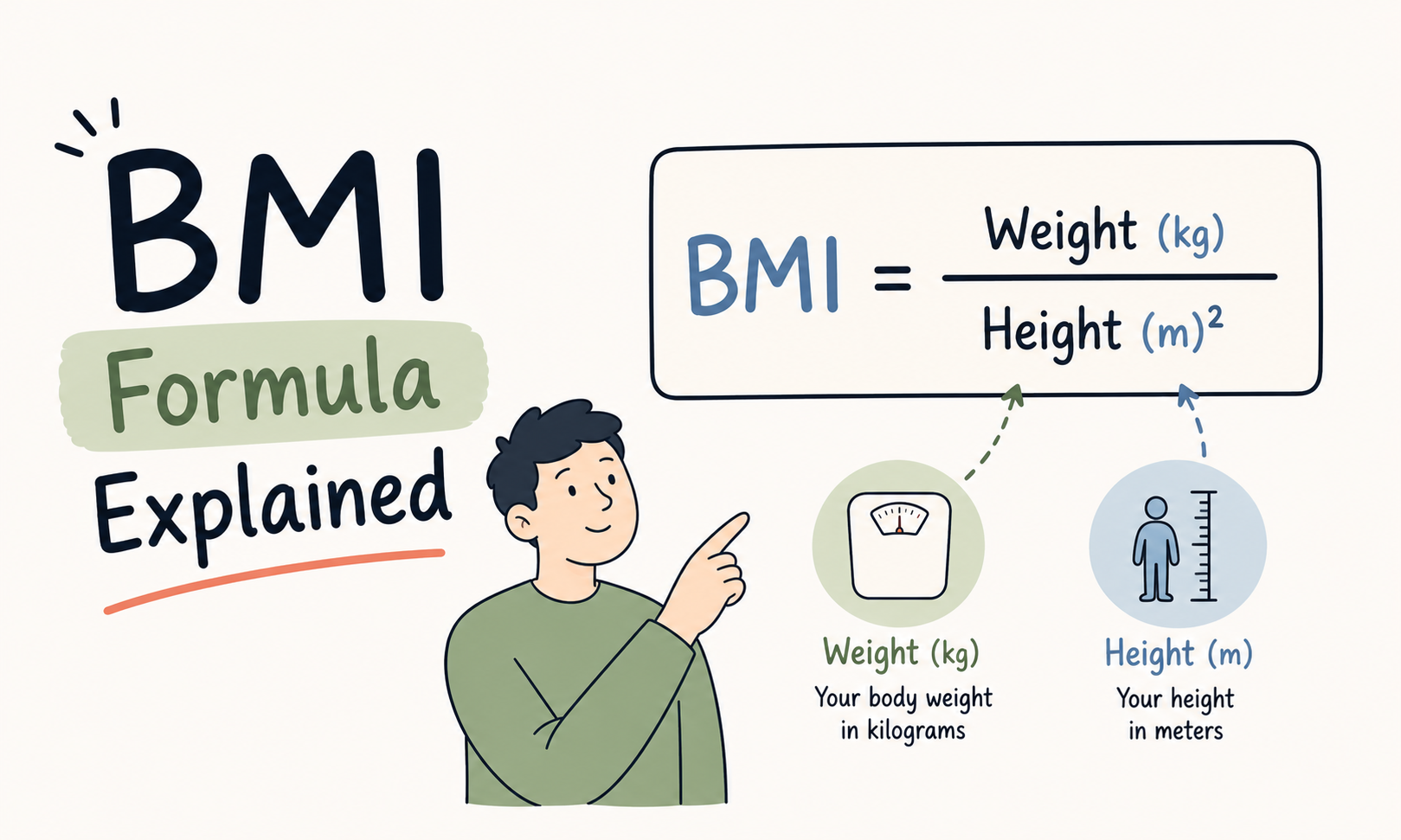
The Body Mass Index (BMI) formula is one of the simplest methods used to estimate whether a person's weight is appropriate for their height. It has been used for decades by healthcare professionals around the world because it is quick, inexpensive, and easy to understand.
Although the formula looks simple, many people wonder why height is squared, why weight has such a significant impact on the result, and whether the calculation is accurate for everyone. This guide explains the BMI formula in plain English, helping you understand how it works and how to interpret your results correctly.
Understanding the BMI Formula
BMI is calculated by comparing your body weight with your height. The formula estimates whether your weight falls within a healthy range for someone of your height.
The standard metric formula is:
BMI = Weight (kg) ÷ Height² (m²)
For countries using pounds and inches, the formula becomes:
BMI = (Weight (lb) × 703) ÷ Height² (in²)
The number 703 is simply a conversion factor that allows imperial measurements to produce the same BMI result as the metric formula.
Example
Suppose you weigh 68 kilograms and are 1.70 meters tall.
BMI = 68 ÷ (1.70 × 1.70)

BMI = 68 ÷ 2.89

BMI = 23.5
A BMI of 23.5 falls within the Healthy Weight category.
The formula is intentionally simple so it can be used by healthcare providers, fitness professionals, and individuals without requiring specialized equipment.
Why Height Matters in BMI Calculation
Height plays a major role in the BMI formula because taller people naturally weigh more than shorter people.
Instead of comparing weight alone, BMI adjusts your weight according to your height by squaring your height measurement.
For example:
| Height | Weight | BMI |
|---|---|---|
| 1.60 m | 70 kg | 27.3 |
| 1.80 m | 70 kg | 21.6 |
Although both individuals weigh exactly 70 kilograms, the taller person has a much lower BMI because their weight is distributed across a larger body.
This is why BMI provides a fairer comparison than using body weight alone.
However, height should always be measured accurately. Even a small error of a few centimeters can noticeably change your BMI result.
Calculate Your BMI Instantly
Instead of calculating BMI manually, use the free Howtigo BMI Calculator to get your BMI instantly, along with your weight category and easy-to-understand results.
Why Weight Affects Your BMI
Weight is the other key component of the BMI formula.
As your weight increases while your height stays the same, your BMI also increases.
For example, someone who is 1.70 meters tall would have different BMI values depending on their weight.
| Weight | BMI | Category |
|---|---|---|
| 55 kg | 19.0 | Healthy Weight |
| 65 kg | 22.5 | Healthy Weight |
| 75 kg | 26.0 | Overweight |
| 90 kg | 31.1 | Obesity |
This relationship helps healthcare professionals identify people who may be at higher risk of weight-related health conditions such as:
- Type 2 diabetes
- High blood pressure
- Heart disease
- Sleep apnea
- Joint problems
It's important to remember that BMI considers total body weight, not what that weight is made of. Muscle, fat, water, and bone all contribute to your body weight, which is one reason BMI has limitations.
How BMI Is Calculated for Adults
BMI is primarily designed for adults aged 20 years and older.
The calculation is the same regardless of gender.
The standard adult BMI categories are:
| BMI | Weight Category |
|---|---|
| Below 18.5 | Underweight |
| 18.5–24.9 | Healthy Weight |
| 25.0–29.9 | Overweight |
| 30.0 and above | Obesity |
Healthcare professionals often use BMI as an initial screening tool before considering additional health measurements such as:
- Waist circumference
- Blood pressure
- Cholesterol levels
- Blood sugar
- Physical activity
- Medical history
For children and teenagers, BMI is calculated differently because it takes age and sex into account using growth charts.
Adults should remember that BMI is only one indicator of health and should not replace professional medical advice.
BMI Formula FAQs
Is the BMI formula accurate?
For most adults, BMI provides a reliable estimate of weight status. However, it may not accurately reflect body composition for athletes, bodybuilders, pregnant women, or older adults.
Why is height squared?
Squaring height helps account for differences in body size. This allows BMI to compare people of different heights more fairly.
Does BMI measure body fat?
No.
BMI estimates weight relative to height but does not directly measure body fat percentage.
Can two people have the same BMI but different body shapes?
Yes.
Someone with high muscle mass may have the same BMI as someone with higher body fat, even though their overall health profiles differ.
Should I calculate BMI manually?
You can, but using an online BMI calculator is faster, easier, and eliminates calculation errors.
Summary
The BMI formula is a simple mathematical equation that compares your weight with your height to estimate whether you fall within a healthy weight range. By considering both measurements together, BMI provides a more meaningful assessment than body weight alone.
Although BMI doesn't directly measure body fat or account for muscle mass, it remains one of the most widely used health screening tools in the world. Understanding how the formula works allows you to interpret your results more confidently and make informed decisions about your health.
For the most complete assessment, BMI should always be considered alongside healthy lifestyle habits and professional medical advice when necessary.
Find Your BMI in Seconds
Skip the manual calculations and get an instant result with the free Howtigo BMI Calculator. Simply enter your height and weight to discover your BMI and understand what your result means for your health.